
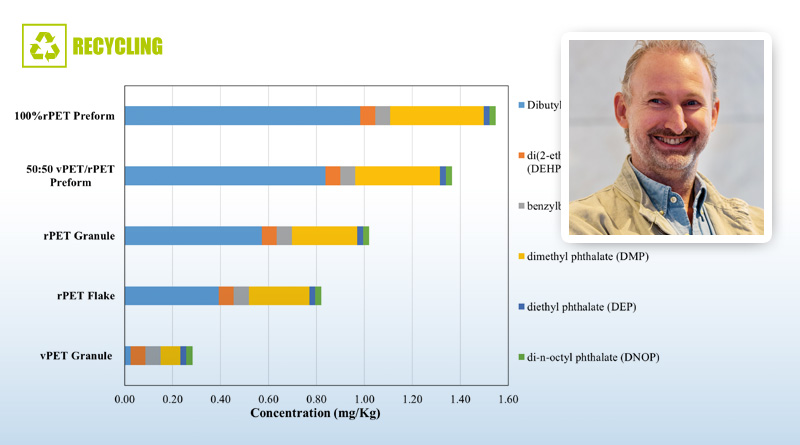
NIAS in PET and rPET
Interview with Casper van den Dungen on the study (Di Duca et al): Occurrence of volatile organic compounds (VOCs) and phthalate acid esters (PAEs) in recycled PET: Implications for food packaging materials
Various factors can lead to the presence and build-up of non-intentionally added substances (NIAS), particularly volatile organic compounds (VOCs) and phthalic acid esters (PAEs), in the rPET matrix. A key driver is thermal degradation that occurs during high-temperature processes such as extrusion and injection moulding. Residual contamination from previous uses can also contribute, while exposure to external substances during collection, storage, or handling may further increase impurity levels. These are the findings of a new study by Di Duca et al., published in the Journal of Chromatography A. PETplanet insider spoke with Casper van den Dungen, Chairman of the NIAS Working Group at PETCORE, about the study and the research insights arising from his work with the NIAS Working Group at PETCORE.
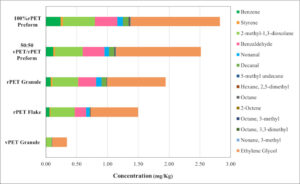
PETplanet: The study found significantly higher concentrations of NIAS in recycled PET compared to virgin PET across all processing stages. How alarming are these findings for the PET recycling industry? (Specifically, the total concentrations ranged from 0.33±0.07 mg/kg detected in vPET granules to 2.82±0.39 mg/kg found in the 100% rPET preforms)
Casper van den Dungen: It is very logical that once you use virgin material in following productions that the level of NIAS will increase. Those levels are caused by the handling of that material in the various treatments which are applied on that material. This can be mixing, drying or melting in an injection moulding extruder. This NIAS generation remains at levels far below the level of concern. We have also seen that the analytical techniques used need to be carefully chosen and applied.
PETplanet: We know that the samples were sourced from “a well-established producer within the European Union”, the study claims. Do you already have data on how big the differences in contamination are between bottles from a DRS and those from a general waste stream?
Casper van den Dungen: As you know, the level of foreign materials in a DRS is limited to those which are in the DfR (Design for Recycling Guidelines) of the food-bottles collected with the exception where for example the DRS system is mixing cans with PET bottles. In this case, little pieces of cans will be generated during the decompaction process, by mechanically deforming the bottles & cans. It results in some cross contamination from the coatings present in the can in the PET.
But generally, the presence of foreign materials and containers that were used for non food applications is lower in DRS than in a multi-material collection system. Consequently, DRS sets a base that eases the control of NIAS.
PETplanet: The study found benzene, a known carcinogen, consistently present in recycled PET samples. What decontamination strategies during the recycling process has the NIAS Working Group identified as most effective for removing or reducing benzene levels, and are current super-clean washing and solid-state polycondensation steps sufficient?
Casper van den Dungen: Many years ago, the industry has found that the PVC which was used in labels of the bottle was acting as a precursor to create extra benzene in the rPET. After a very effective market information, this precursor was reduced very radically. This results in very low levels of benzene in the current rPET market. The creation and deployment of DfR guidelines – that have identified PVC components are detrimental to the recycling process – has strongly helped the control of benzene and is now the base to anyone willing to put a PET bottle on the market. Furthermore, the recycling technologies have proven to be robust since years enough to cope with such contamination and rPET pellets have the same level of safety as virgin PET for food contact (EFSA approved).
PETplanet: The study examined samples across the recycling chain from flakes to preforms. Where should recyclers focus their quality control efforts? Is there a critical control point in the process where intervention is most effective?
Casper van den Dungen: If we want to turn PET circular, we need to ensure that the PET containers, bottles or trays, have been designed for recycling. Only then it makes sense to collect them and secure their next rebirth in a following cycle. After every purification cycle, key limits are set which will help to secure the required quality in the next cycle. Analysis of NIAS should currently be done according to the PING – PET Industry Nias Group. The version 2019 is currently available and our Lab Cluster where more than 40 laboratories are participating is currently working on the creation of a more developed ‘industry standard’ for NIAS measurement in PET resins and packaging. Intent is to publish this by mid-2026. Recyclers will control the NIAS in pellets before they get converted into a new packaging.
PETplanet: For brand owners demanding higher rPET percentages, how should they balance recycled content targets and compositional/NIAS risks?
Casper van den Dungen: As said previously the potential mistakes in a cycle are related to their origin, the recyclability of the designs is the main contributor, but also at the accumulation of their modules or steps toward the next cycle. The collection and washing are important modules which will reduce the % level of non-PET to a ppm level of impurities. This will then create a ppb level of NIAS effect which we need to be monitored. In short these are big steps, but the current systems in the market have proven to be able to handle these successfully over already a long period of time.
PETplanet: PETCORE is developing a central NIAS databank and standardised reporting. How will PETCORE handle confidentiality vs transparency for industry partners who supply proprietary compositional or process data? What information will be mandatory to make the databank useful?
Casper van den Dungen: The database we currently are developing, is using a web-based platform with a state-of-the-art data protection, we also anonymise the data for the statistical analysis as we did for our consortium on the Functional Barrier. An agreement between PETCORE EUROPE and the data owner frames that PETCORE can have access to create the statistical analysis and benchmarks. The more a company is sharing with PETCORE EUROPE, the more detailed the analysis and benchmarks will be. And the data needed will vary from one point of the value chain to another. Monitoring should contain the required details to improve and control the NIAS levels.
PETplanet: Looking ahead: what are the top research or industry actions you think are essential as the next steps to reduce NIAS uncertainty in food-contact rPET (method harmonisation, databank completion, technology upgrades (eg. chemical recycling as super cleaning step), regulatory alignment, or something else)?
Casper van den Dungen: The PET value chain has been working since years to create the actual safe situation as regards NIAS. State-of-the-art equipment and procedures have been deployed, investments in process equipment, lab equipment and staff in all steps from collection, recycling and packaging production have created a strong base.
For the future, the below changes will occur and adaptation will be needed:
Detection limits of NIAS will keep on lowering, and new substances will come into focus like PFAs recently. Then the industry will need to keep standardising and improving analytical techniques. The screening methods are already well advanced for the lower molecular weight; progress will be needed for substances with higher molecular weight.
Increased circularity of PET will be a game changer. This is a new territory, and we need to gather as many data as possible to create trends and predictive tools. This will allow us to anticipate changes, guide the industry and keep food safety at the highest standard. We call on the whole value chain to supply analytical data for our GENI initiative. It aims at gathering NIAS data all along the value chain and with a sufficient frequency to feed statistical predictive models.
PETplanet: Thank you very much Casper!
The study can be found here