
Big bag to big bag
FIBCs made from 100% rPET
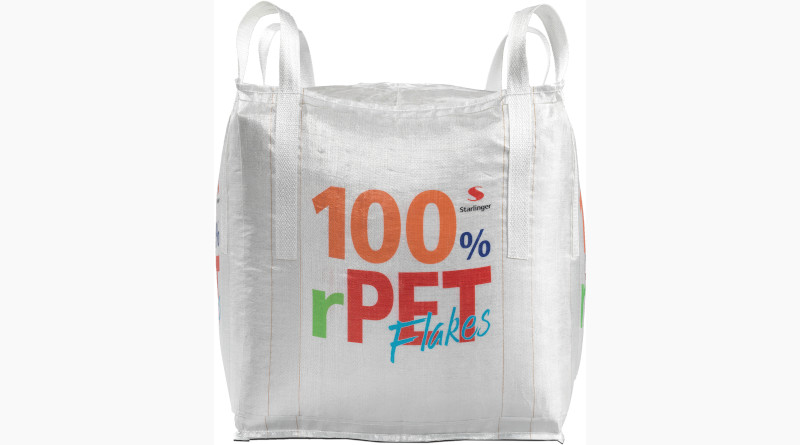
Austrian company Starlinger & Co GmbH applies its expertise in PET recycling to offer a circular system for Flexible Intermediate Bulk Containers (FIBCs), also known as big bags, which are commonly used for packaging dry bulk goods.
Increase sustainability, reduce plastic waste: Companies in almost every industry worldwide face the need to put these two goals into practice. In the area of woven plastic packaging for dry bulk goods, Starlinger, a supplier of technology for woven plastic bag production and plastics recycling equipment, offers FIBCs made entirely from recycled PET as a practical option.
FIBCs are omnipresent in logistics as a lightweight and economic type of packaging for free-flowing bulk goods. Made predominantly from polypropylene (PP), they show a CO2 balance per 1,000 L of transported goods that is far below that of rigid containers such as drums or octabins. Most of the FIBCs, however, are designed for single use, and their disposal via landfill or incineration causes environmental damage with high CO2 impact.
Due to environmental regulations such as the UK Plastic Packaging Tax, the European Union’s Packaging and Packaging Waste Regulation, aiming for a more sustainable plastic packaging, recyclability and recycled content in plastic packaging is becoming an increasingly important topic also for FIBC producers.
Big bag to big bag – 100% recycled
FIBC fabric made entirely of rPET is a sustainable alternative to single use PP for FIBC producers. Besides its high strength and form stability, which makes PET fabric perfect for heavy-duty applications, PET can be recycled and refined so that its properties are the same as those of virgin material. With a method called solid-state polycondensation (SSP), the molecular weight of rPET can be restored to its original level, thereby yielding material that is literally ‘as good as new’. Similar to bottle-to-bottle applications, big bags can be produced from 100% rPET using Starlinger tape extrusion and circular weaving technology. This means that with PET, the recycled content of a FIBC can even be up to 100%.
FIBCs produced from 100% rPET on Starlinger equipment are claimed to meet all the required safety criteria and do not differ from conventional FIBCs in terms of construction and handling. Due to their high tensile strength and creep modulus, PET FIBCs are perfect for long-term storage or for packaging dry bulk goods with high flow characteristics and thus provide an economical alternative to IBCs (Intermediate Bulk Containers) made from rigid plastics, metal or cardboard.
Technology is the key
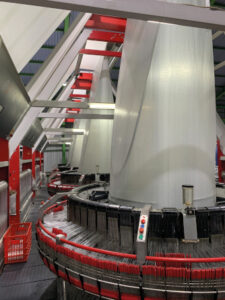
Starlinger has been working since 2010 on developing the process and equipment for converting PET into woven fabric – initially from virgin material, then recycled pellets, and ultimately, from PET flakes. According to Starlinger, this was something that no technology provider had managed to achieve until this point, as the use of PET for tape production entails many challenges. The company now offers the full equipment for rPET FIBC production – from PET recycling lines to PET/rPET extrusion all the way to the corresponding technology for weaving. Starlinger’s latest PET recycling systems include the recoSTAR PET ART recycling extruder for rPET pellet production and the viscoSTAR SSP reactor for IV increase and decontamination of rPET pellets or flakes.
Starlinger says that FIBC producers in Latin America and Asia are already using their technology for rPET FIBC production, ensuring closed-loop packaging for the dry bulk sector.