
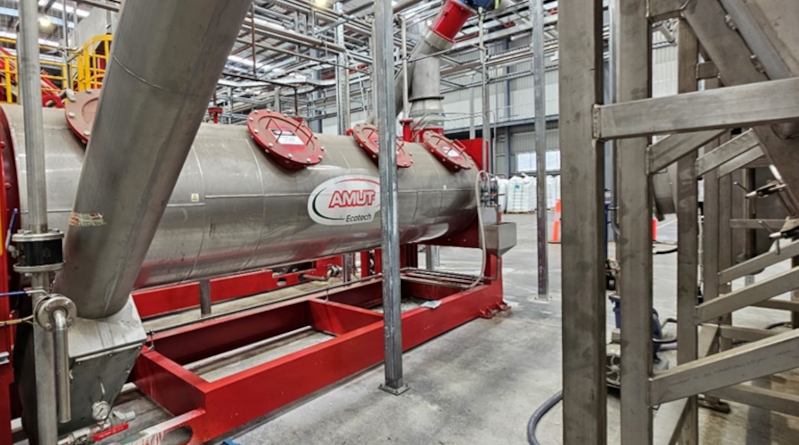
Proven industrial solution for multilayer PET tray circularity
Trays play an important role in food preservation, extending shelf life and reducing spoilage through barrier performance. However, their multilayer composition, combining PET with barrier polymers, poses challenges for recycling systems designed for mono-material streams. To protect product purity, many facilities reject multilayer trays during sorting, which reduces yields and limits the availability of high-quality recycled PET (rPET) for food-contact applications.
After years of research and industrial validation, AMUT has patented a tray-to-tray process designed to handle mixed mono- and multilayer PET trays without pre-sorting or exclusion.
The system is operational at industrial scale, producing recycled flakes that meet food-contact standards and allowing PET trays to be reintegrated into production.
Central to the process is AMUT’s patented Friction Washer, a washing unit that performs two functions simultaneously:
- Thorough cleaning to remove organic residues and fines;
- Mechanical delamination, separating multilayer structures during washing.
The result is a stream of hot-washed PET flakes suitable for sheet extrusion and thermoforming into new trays. By processing multilayer materials directly, the system allows recycling facilities to recover PET content that might otherwise be discarded.
Key benefits include:
- Reduced material rejection: multilayer trays remain in the recycling stream
- Higher recovery rates: more collected PET is converted into rPET
- Simplified operations: no need for extensive sorting or parallel lines
- Consistent food-grade output: compliant with EFSA and FDA standards.
Rather than representing a minor upgrade, this approach demonstrates how recycling systems can manage complex materials at scale, says AMUT.
Industrial scale
AMUT’s tray-to-tray lines have shown stable, continuous operation using feedstocks with significant proportions of multilayer trays. The company states that the system can handle variable input streams without compromising output quality.
Bridging food preservation and circularity
Europe faces the dual challenge of reducing food waste while increasing plastics recycling. These objectives are often seen as conflicting, but emerging technologies indicate they can be pursued together. Multilayer PET trays are a pillar for maintaining food freshness and shelf life. Replacing them with simpler materials could increase food waste, potentially offsetting gains from easier recycling. Conversely, excluding multilayer trays from recycling reduces available feedstock and raises costs across the value chain. Processes such as tray-to-tray aim to keep complex materials within recycling streams, supporting both material recovery and environmental performance. This approach illustrates the practical reintegration of multilayer PET into productive use.
Implications for the industry
Recycling technologies that can handle mixed and multilayer PET trays may strengthen the circular value chain:
- Recyclers can improve plant efficiency and reduce residue disposal.
- Converters can access food-grade rPET flakes for sheet extrusion.
- Brand owners and retailers can achieve recycled-content targets without compromising food safety.
- Consumers and regulators receive evidence that advanced packaging can be recycled effectively.
Such approaches are claimed to demonstrate that complex post-consumer materials can be converted into a renewable resource, supporting circularity in practice.