
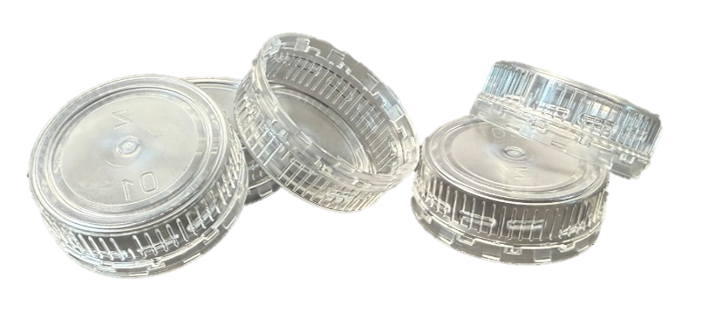
100% PET closure becoming industrial reality
For years, the packaging industry has been working toward a truly mono material bottle system that enables high quality, closed loop recycling. While PET bottles are already the established global standard, the HDPE closure has remained the last barrier to a fully unified material stream. Today, this long standing separation could soon come to an end. A fully functional 100% PET closure, developed by Austrian injection moulding specialist Z-MOULDS, has moved from a bold engineering vision to an industrially testable solution.
The idea itself was often viewed as technically improbable. PET, unlike HDPE, lacks the elasticity needed to handle the deformation typically required for demoulding and high speed application. Threads, retention lugs and tamper evident bands present geometries that historically made PET unsuitable for closure manufacturing. Overcoming these barriers required not only a rethinking of closure architecture but also the development of a patented moulding concept capable of managing the material’s demanding behaviour.
Z-MOULDS created a closure that is recyclable and industrially viable. The resulting solution is built on the well-established patented z-slides technology with an additional rotation mechanism within the mould, enabling the controlled release of complex undercuts and the precise formation of a folded tamper evident band. As a result, the closure behaves compliantly during capping while retaining the necessary rigidity during use – a balance that PET had previously failed to achieve.
Crucial to the speed and reliability of this development was the involvement of two major technology partners: NETSTAL Maschinen AG, contributing machine expertise and processing excellence, and MHT Mold & Hotrunner Technology AG, providing advanced hotrunner know how. Their combined capabilities enabled Z-MOULDS to accelerate sampling, refine steel adjustments efficiently, and validate functionality under realistic production conditions. The close collaboration among the three companies is seen as a key factor behind the unusually fast progression from prototype to industrial testing.
Laboratory evaluations have shown that the PET closure performs on a level comparable to established HDPE solutions. Sealing integrity, opening torque and band behaviour are claimed to meet industry expectations, while cycle times between 3s and 4s keep manufacturing costs competitive. For recyclers and brand owners, this approach has practical implications: using PET for both bottles and closures increases material purity, which can improve recyclate quality and simplify downstream processing.
Having successfully completed pilot mould trials, Z-MOULDS is now moving into industrial scale testing and preparing to adapt the closure concept to additional neck finishes and lightweight formats. If performance under real line conditions confirms the laboratory results, the development could become one of the most meaningful advances in circular beverage packaging in recent years – offering a practical pathway toward a truly mono material PET ecosystem, the company claims.